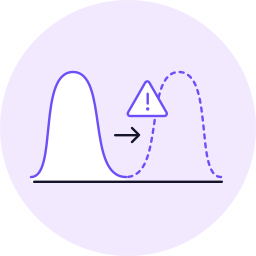
Judge
Temporal Stability & Distribution Shift
Is the system still reliable over time?
Signals when a model's reliability may have drifted since deployment, so trust tracks current performance.
- Evidence: research-based (Quiñonero-Candela et al. 2009, Rabanser et al. 2019)
- Tested: concept only, mock data
Overview
Why it matters
Models don't break. They drift, and the interface looks the same.
A model works well at launch. Months later the world has changed, the cases look different, and the outputs quietly get worse. Unlike broken software, a drifting model doesn't fail visibly. People have no way to tell whether today's system is as reliable as the one they evaluated.
Confidence & Uncertainty covers one output at one moment. This pattern covers whether the system as a whole still holds up over time.
What does it look like?
Caseworker notices a model freshness warning
Caseworker notices a model freshness warning
- Caseworker opens a risk assessment for a new application.
- Interface shows: "Model last validated: 14 months ago."
- A prompt appears: "Extended time since last validation. For borderline cases, consider additional human review."
- Caseworker notes the borderline score and flags the case for specialist review before finalising the decision.
Performance monitoring triggers a team alert
Performance monitoring triggers a team alert
- A data team monitors model performance in an internal dashboard.
- Accuracy on a specific applicant segment has dropped 8 percentage points over three months.
- A revalidation prompt surfaces in the operational interface: "Performance drift detected in [segment]. Revalidation recommended before continuing to use this model for final decisions."
- Team initiates a model review cycle.
User questions why predictions feel inconsistent
User questions why predictions feel inconsistent
- A caseworker raises a support query: decisions lately seem inconsistent with their professional expectations.
- The data team reviews the distribution drift dashboard and identifies a measurable shift in income distribution patterns following a macro-economic change.
- A temporal caveat is added to the interface and a retraining cycle is initiated.
- The caseworker is notified of the model update and what changed.
When does it fit?
Use it when
- The system's reliability depends on conditions that change over time
- A lot of time has passed since the last validation
- Monitoring shows that inputs or performance have shifted
Skip it when
- The model is retrained continuously on fresh data
- The deployment is too short-lived for drift to matter
- Warnings would cause harmful over-caution: use thresholds, not permanent notes
Design
How do I apply it?
-
Show model age where decisions are made.
If a model hasn't been revalidated in 18 months, the caseworker should see it, not only the data team.
-
Use thresholds, not permanent warnings.
A constant disclaimer becomes invisible. Trigger alerts at defined limits, and clear them when resolved.
-
Pair every drift signal with a next step.
Flag for review, add caution, or route to a specialist. Signals without actions are noise.
-
Only show drift you actually measure.
A drift badge without monitoring behind it destroys trust when people look closer.
-
Keep model age and data age apart.
A recent model can run on stale data, and the other way round. Show both.
For your data team
Distinguish covariate shift (the distribution of inputs has changed) from concept drift (the relationship between inputs and outcomes has changed). Concept drift is harder to detect and more consequential. Detailed drift metrics and calibration plots belong in practitioner views; caseworkers need a simple age and status signal.
How can I show it?
Model freshness indicator
When the model was last validated, and how long ago.
A visible label or badge showing the model's last validation date and elapsed time in production: "Last validated: March 2026 (8 months ago)." Present in the interface at the point where decisions are made, not only in documentation or admin panels.
Temporal caveat microcopy
A short note on what time period the model knows.
A short, persistent qualifier on model outputs in time-sensitive domains: "Trained on data through [date]. Performance in current conditions has not been independently validated." Less disruptive than a warning banner; establishes the right baseline expectation for users who read it.
Data freshness indicator
When the input data was last updated.
Distinct from model freshness, this shows when the input data pipeline was last updated or where training data ends. "Training data: through Q2 2025." Distinguishes between a stale model and stale input data feeding a current model. Both matter and require different responses.
Training data ends here cutoff marker
Where known data ends and forecast begins.
In interfaces that visualise time-series data or generate predictions into the future, a clear visual marker showing where observed training data ends and the modelled forecast begins, making the boundary between known history and extrapolated projection legible.
Revalidation prompt
A visible prompt once a revalidation limit is crossed.
A visible, actionable prompt, not buried in an admin panel, that surfaces when a revalidation threshold has been crossed. "This model has been in production for 12 months without revalidation. A performance review is recommended before continuing to use it for high-stakes decisions." Includes a clear escalation path (flag for data team, route borderline cases to specialists).
Distribution drift alert
A warning when recent cases differ from the training data.
A warning that appears when current input data is detectably different from the training distribution, not just for a single out-of-distribution case, but systematically across many recent cases. "Note: The profile of applications received this month differs significantly from the training data. Treat results with additional caution and consult your data team."
Performance trend indicator
Whether accuracy or fairness has changed since launch.
Where downstream metrics are monitored: a visible indicator of whether accuracy, calibration, or fairness metrics have changed since launch. Can be as simple as a trend arrow with a timestamp, or a small sparkline. Intended for operator and supervisor views, not end users.
Further left for caseworkers, further right for data and compliance teams.
What does it cost?
Transparency vs. alert fatigue
Permanent staleness warnings become noise. Tie alerts to real measurements and to the stakes.
Honesty vs. disruption
A revalidation prompt can slow work even when the model is fine. Decide who acts at which threshold.
Simple vs. detailed signals
Model age for caseworkers, drift metrics for data teams, revalidation status for compliance.
Connections
Which patterns work with it?
Confidence & Uncertainty
How certain is the system?
Uncertainty addresses output-level confidence for a specific prediction. Temporal stability addresses system-level reliability over time. A drifting model often shows increasing output uncertainty: the two patterns can reinforce each other.

Model Scope & Limits
What can this system reliably do?
Scope and limits define where the model was designed to operate. Temporal stability addresses whether it still operates reliably in those conditions after deployment.

Model Transparency Cards
How was this system built and tested?
Transparency cards document training data dates and performance conditions at launch. Temporal stability requires that documentation be kept live and updated, not just accurate on release day.

Audit Trail & Logging
What is the complete record of this decision?
A complete audit trail should record the model version and validation date at the time of each decision. If the model is updated, the audit trail must reflect when and why.

Data Provenance & Lineage
Where does this data come from?
Data freshness is upstream of temporal stability. An interface already surfacing data provenance has the foundation to add training cutoff dates and recency signals.
Sources (4)
Sources (4)
Quiñonero-Candela et al. (2009) — Dataset Shift in Machine Learning
foundational technical treatment of covariate shift, concept drift, and their implications for deployed model reliability. Provides the taxonomy this pattern operationalises for non-technical audiences
Rabanser et al. (2019) — Failing Loudly: An Empirical Study of Methods for Detecting Dataset Shift
empirical comparison of methods for detecting input distribution shift in deployed systems. Informs the conditions under which drift signals can be credibly surfaced in an interface
Raji et al. (2020) — Closing the AI Accountability Gap
argues that accountability requires ongoing monitoring, not just pre-deployment evaluation. Provides the governance rationale for making temporal stability signals a first-class interface concern
Gebru et al. (2018) — Datasheets for Datasets
the framework for documenting dataset composition, collection dates, and recommended use directly supports the model freshness and training cutoff signals this pattern requires
Your model was validated once, and nobody has looked since.
Risk scoring, fraud detection, triage and forecasting are where silent drift hurts most. That's where this pattern starts. Let's look at your interface together.
Work with me